


.png)

Key Takeaways
Predictive fault detection provides a significant advancement in HVAC operations by enabling continuous performance monitoring and early fault identification. By analyzing high resolution operational data, data analytics to detect deviations that are invisible to traditional reactive maintenance. This reduces unplanned downtime, optimizes energy performance, stabilizes comfort conditions, and extends equipment lifespan. As buildings become more connected and energy expectations increase, predictive maintenance will become a core component of intelligent facility management. It transforms HVAC systems into measurable and proactively managed assets, supporting long term reliability and operational efficiency across large building portfolios.
HVAC systems are responsible for regulating thermal comfort, air quality, and ventilation inside commercial buildings. They operate continuously, adapt to changing loads, and consume a major share of total energy usage. Despite this critical role, the maintenance model used for HVAC systems in many buildings remains largely reactive. Technicians address issues only when a fault is discovered, usually during a complaint, routine inspection, or complete system failure.
This traditional approach leaves a large performance gap. Small deviations often grow into major problems, energy usage increases before anyone notices, and equipment stress accumulates over months or years before it is detected.
With the rise of connected sensors, advanced data acquisition hardware, and scalable analytics infrastructure, it is now possible to monitor HVAC systems in real time and detect anomalies long before they become failures. This shift from reactive to predictive fault detection is reshaping building operations and improving the reliability of some of the most essential equipment in commercial infrastructure.
The Hidden Cost of Reactive Maintenance
Most facilities operate with a mix of two maintenance strategies.
Time Based Preventive Maintenance
This follows a fixed schedule, usually monthly or quarterly. It helps catch common problems like dirty filters, worn belts and incorrect refrigerant levels. Although structured and predictable, it does not track what happens between visits.
If a fault starts developing in week two of a twelve‑week cycle, it may continue to degrade for ten weeks before anyone checks the system again.
Corrective Maintenance
This is the familiar approach of fixing equipment after it breaks. The issue is that many faults do not appear suddenly. They develop quietly.
Take an example of a refrigerant leak. A small leak will not trigger an immediate alarm. The chiller will continue to run, but with lower refrigerant and lower oil return. Over time, this causes bearing wear, and higher discharge temperatures. By the time the system trips on low pressure, what could have been a small repair becomes a major compressor issue.
The real problem with reactive maintenance is not how quickly technicians respond. The problem is that the fault is already advanced when it becomes visible.
What Predictive Fault Detection Actually Does
Predictive maintenance is condition‑based instead of calendar‑based. Instead of checking equipment at fixed intervals, it monitors the actual health of the system continuously. It identifies issues when they are still small, long before they reach the point of failure.
The foundation of predictive maintenance is continuous operational data. For HVAC systems, this includes parameters such as chilled water temperatures, suction and discharge pressures, compressor power, condenser and evaporator approach temperatures, and vibration signatures. Most modern systems already generate this information. The question is whether it is being used effectively.
Predictive capability comes from Fault Detection and Diagnostics, or FDD. This analytical layer evaluates the live stream of data, identifies patterns that are not normal, and classifies them into likely fault types. Without FDD, data simply sits in a log. With FDD, building operators can identify a chiller showing early signs of condenser fouling weeks before the problem affects cooling performance.
Predictive detection goes beyond simple threshold alarms. It understands how an HVAC system should behave under different loads and conditions and flags of deviations that the human eye may not notice.
What Predictive Fault Detection Actually Does
Predictive maintenance (PdM) sits above preventive maintenance in the reliability engineering hierarchy because it's condition-based rather than time-based. Instead of scheduling intervention on a calendar, PdM monitors the actual health state of equipment continuously and triggers action when the data indicates a fault developing before it reaches the failure threshold.
The technical foundation of PdM is continuous operational data at a sufficient interval to detect trend changes early. For HVAC systems, that means parameters like supply and return chilled water temperatures, refrigerant suction and discharge pressures, compressor amp draws and shaft power, condenser and evaporator approach temperatures, and vibration signatures on rotating components.
Most modern HVAC systems already generate huge amounts of operational data. The real question is simple: is anyone using it for more than looking back after something breaks?
What turns raw logs into real predictive power is Fault Detection and Diagnosis. This is the analytical engine that reads every data point, learns what normal looks like, spots patterns that do not belong and links them to specific fault types.
With proper FDD, the system can tell the difference between a chiller running smoothly and a chiller showing the earliest signs of condenser tube fouling. It can spot this weeks before it affects performance or reliability.
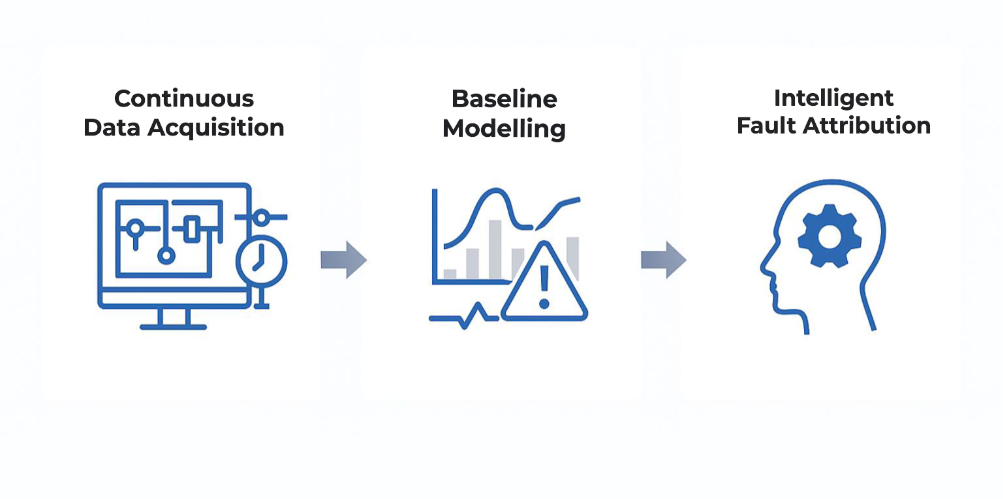
How Predictive Fault Detection Works
Continuous Data Acquisition
The system captures real‑time performance data: air temperatures, refrigerant pressures, compressor current, fan speed, VFD output, water temperatures, condenser pressure and coil delta T. Together, this creates a complete, high‑resolution fingerprint of how the HVAC unit is actually running.
Baseline Modelling
Machine learning learns what “normal” looks like. It maps load patterns, seasonal behavior, aging curves, refrigeration efficiency and electrical signatures.
These baselines help the system spot changes that static thresholds would never catch.
Real Time Anomaly Identification
Live data is constantly checked against the baseline. The system flags issues like reduced heat transfer, abnormal cycling, unstable superheat or subcooling, capacity loss, current imbalance or airflow restriction. Every deviation is interpreted in context so it is meaningful, not noise.
Intelligent Fault Attribution
Instead of generic alarms, the system identifies what is actually going wrong. It connects the patterns to root causes: fouled heat exchangers, early compressor wear, refrigerant leaks, actuator faults or control instability. This gives teams clear, targeted insight and actionable direction.
Operational Benefits of Predictive Fault Detection
Reduced Unplanned Downtime: Early fault identification prevents sudden failures and improves service continuity.
Lower Energy Consumption: Many faults increase energy consumption long before equipment stops working. Correcting these issues restores efficiency and reduces electricity usage.
Better Maintenance Planning: Maintenance becomes condition‑based instead of time‑based. This avoids unnecessary site visits and improves technician productivity.
Longer Equipment Life: Operating equipment within optimal ranges reduces mechanical and thermal stress. This extends the life of compressors, fans, motors, and heat exchangers.
Portfolio Level Visibility: Multi‑site operators gain a unified view of asset performance. This helps standardize operations and energy performance across all locations.
.jpg)